
Soft Water. Smart Life.
Water Softening RSA (PTH Water) provides a revolutionary, chemical-free hard water treatment solution across South Africa.
Considering Reverse Osmosis?
Reverse osmosis is conceivably the most expensive and most wasteful way of treating water known to modern man – and it strips out the minerals your body needs along with the impurities.
Why is reverse osmosis so expensive and wasteful?
Reverse Osmosis (RO) is conceivably the most expensive and most wasteful way of treating water known to modern man. It treats the water by pushing it through a membrane which removes all the solids, including essential minerals, from the water. The most popular RO system is the 5-stage. This gives you pure water with all impurities and minerals removed.
Although this might seem to be exactly what you want, there is one serious problem: our bodies, and especially those of growing kids, require those minerals for normal growth. We get those minerals from the water we drink, to be absorbed by the body.
The 6-stage RO system puts these minerals back into the water, while the 7-stage adds oxygen.
RO takes around one hour to create 7.5 litres of purified water, but in the process uses an additional 6 litres of water that simply run down the drain. If you use 7.5 litres a day for drinking, that would equate to a water wastage of 180 litres of water per month to get clean drinking water. No household in South Africa – or anywhere in the world, for that matter – can afford such waste.
PTH doesn’t waste water during the softening process and works faster.
The PTH also doesn’t remove the essential minerals from the water.
Is a Resin water Softener a viable option?
Hard water is high in dissolved calcium, magnesium and iron, and it quietly builds lime-scale in your pipes, geyser elements and appliances. The usual answer, a resin softener, brings costs of its own.
Does a resin water softener need salt, power and maintenance?
Hard water contains high levels of dissolved calcium, magnesium, and metals such as iron. The greater the amount of total dissolved minerals (TDS) in the water, the harder it is. Hard water causes lime-scale build-up in pipes and electrical elements heating water. It is also damaging to all household appliances like washing machines, dishwashers and air-conditioning systems.
A water softener is installed in the main water supply line to your home. There is a manual, semi-automatic and fully automatic system. It must be connected to the electricity supply. The system needs periodic maintenance. The resin needs to be replaced.
It also needs to be regenerated periodically with a brine rinse, at considerable cost. Because of the many disadvantages associated with resin softeners – health risks, undrinkable water, polluting the soil with the brine rinse-off and others – resin softeners are increasingly being banned world-wide.
PTH softens your water without all the disadvantages associated with resin softeners.
PTH System – the best choice.
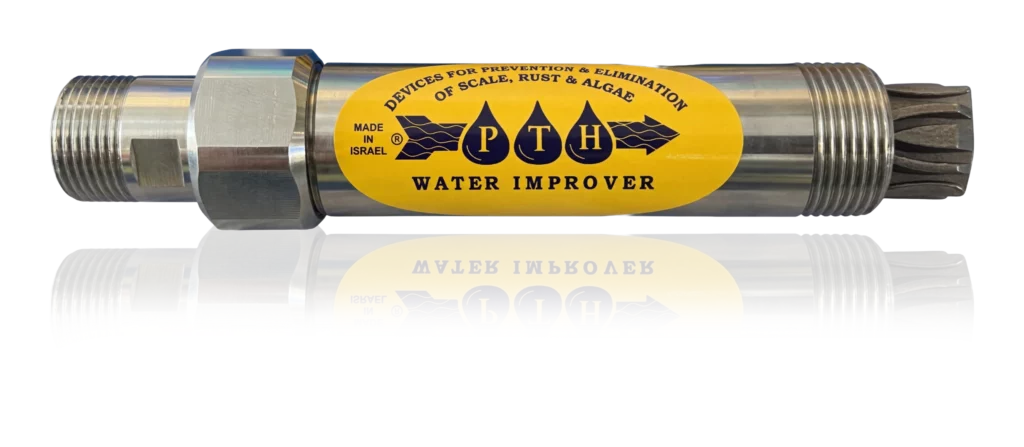
The PTH installs directly into your main water supply and works as both a descaler and a water softener – without electricity, salt or costly maintenance.
How does the PTH work without salt, chemicals or electricity?
The PTH system is a unit that is installed directly into the main water supply of your home. PTH units function without electricity supply, are easy to install and do not require costly maintenance.
PTH has a dual function, acting as both a descaler and water softener. This two-in-one combination results in a better tasting drinking water directly from your tap without removing the minerals necessary for your good health.
In addition, the system will also over time remove scale and rust from your water pipes and electrical elements, making everything last longer and saving you money.
With PTH-softened water at the turn of a tap, you will need to use less washing powder. When washing your car, those white marks left behind when the water dries can now simply be dusted off. Your garden and plants will thrive with better quality water.
PTH Water Improver
The Simple Solution to Hard Water Problems

no electricity

no chemicals & salt

no maintenance

no moving parts

no service

no cartridges
Case Studies
You do not need to take our word for it. The PTH has been tested time and time again.
Entire mining villages protected by PTH
Report on an experiment about the efficacy of the PTH water treatment System carried out in the kumba iron ore town of Kathu
Background
In November 2014, representatives of PTH Water South Africa and Sishen Iron Ore met on site for a follow-up inspection of the PTH product after Kumba Iron Ore had ordered 80 units of the PTH Descaling and Softening system.
As a courtesy, an additional PTH15 was supplied by PTH Water South Africa. This unit, supplied with the compliments of PTH Water, was fitted to House 91 A on 20 November 2014 by the Mine’s own maintenance team, under the direction by PTH Water.
On 25 February 2015, the geyser and pipes of House 91 A were opened up and inspected. Photographs were taken.
Findings
1. The Pipework
As can be clearly seen in the before and after photographs, the pipework has cleaned up completely – as the suppliers claimed it would. Before the PTH was fitted, a man’s little finger could not even fit in, due to the extent of the scale. As can be seen, it is now completely scale-free.
2. The Geyser
The geyser was totally scale-free on the inside when opened, while the geyser next door (used as a scientific control) was covered in scale, even though it had been serviced recently. Before the PTH was installed, the element was totally scaled up.
What is remarkable, is that House 91 A was not occupied for part of the trial period, resulting in an extremely erratic flow rate.
Conclusions
• Properly installed, this is irrefutable proof that the PTH system prevents and removes existing scale.
• If we look at the previous photographs taken at our first inspection last year, where the PTH elements were compared with those using a resin-based system, the PTH protected elements were no worse – if anything, they were less coated – yet they performed with none of the disadvantages of the resin-based system, and at much less cost.
• The PTH investment is less than R10 000, incl VAT and delivery, compared with R25 000 for the salt system
• At a proven 72% to 92% efficiency rate, the PTH will extend the life of geysers, elements and other appliances by at least these percentages – without any extra cost.
• Maintenance of the PTH is virtually nil: simply brush the inner core every second year, nothing to replace, and labour time approx 10 minutes. Compare this to the salt softener that needs attention every third month.
• The PTH is environmentally friendly (no soil-destroying salt backwash or chemicals of any kind. As a result, many communities around the world have banned these resin softeners.).
• No power source required; unit simply requires earthing. Rolling blackouts do not affect its performance.
• Unbreakable, and no replacement parts needed.
• Quick and easy to install.
• Improves the taste of the water (while the resin softener increases the salt content and renders the water virtually undrinkable.).
• PTH-treated water is healthy. The water is soft on the skin (it has been known to improve psoriasis), while the retention of the calcium and magnesium in the water is vital for bone, hair and nail growth (the salt softener takes out these important minerals). Medical doctors recommend PTH treated water for health reasons.
• Of all the types of devices tested in this exercise, only the PTH managed to stabilise the pH of the water at 7.2.
Because of the multiple hazards they pose to human health as well as the environment, saltwater systems have been banned in many places world-wide.
In summary:
Without the PTH water softener, the mine would have been faced with astronomical repair and replacement costs.
Read an insightful endorsement from Prof. Loewenthal (UCT) here.
Whole buildings and blocks of flats covered by a single PTH
The PTH Water system is in actual fact an inline water catalyst. It works on the same principle as a diesel engine’s exhaust catalyst that changes the harmful exhaust gasses to environmentally-friendly gasses as dictated by European environmental legislation, that can change the chemical composition of the “bad” compounds in the water to more “friendly” compounds for plants. It will lessen the scale build-up in the irrigation system – drippers, sprayers and pivots – and it will also change the current water to a “wetter water”: this penetrates the soil much faster and is absorbed almost immediately by a plant, product or cash crop.
It is also very important to select fertilizers that will not add to your chemical “problem” in your water. If possible avoid fertilizers with high Cl and Na as an example. As a suggestion I would flood the “problem” area with municipality water to leach out whatever is in the grow area of the grass. Then take a ground sample and send it to BEM-lab and act on the result on the analysis. You can then use PTH treated water with the correct fertilizer for your greens. It is also important to compare the water analysis to that of what the required standard is for grass, if you intend using the PTH treated water on grass.
Multiple treatments
More than one unit can be combined to service huge set-ups.
An industrial-sized PTH in operation at a prestigious golf club saves its owners up to 40% on irrigated water, as well as ensuring that the putting greens and driving ranges remain in tip-top condition.
The bowls club in Gansbaai uses a PTH for the same purposes, in spite of having water extremely high in sodium and chloride.
PTH in action: This lush lawn belongs to Tonie Nel of Velddrif, whose borehole water has sodium (Na) levels approximating nearly 2000 mg/L and a chloride (Cl) reading that stands at a staggering 3212 mg/L! No other comparable product can render waters so high in salinity treatable.